
Old Cemetery - English
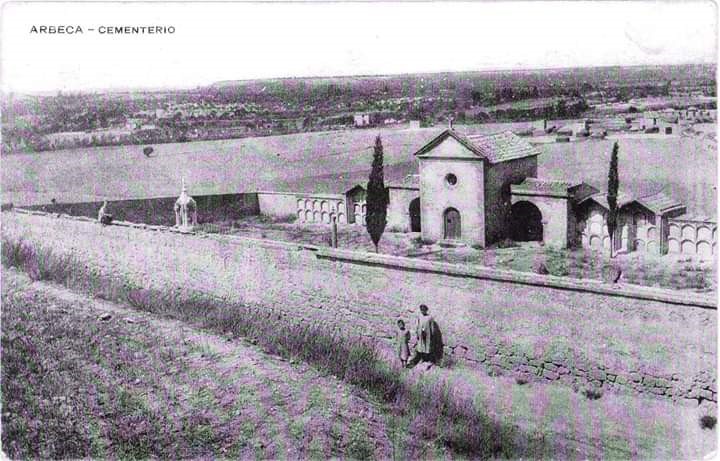
The first documented cemetery in Arbeca was the Fossar de Sant Joan (St John’s Burial Ground), located outside the town walls, opposite the gate of the same name. During the Peninsular War (1808–1814) and, above all, the First Carlist War (1833–1840), both the fossar and the small adjoining chapel suffered severe damage, as many of their stones were used to reinforce the town’s defenses. In response to this situation, the authorities ordered the construction of a new cemetery.
The Town Council acquired land beneath the castle hill, on the northern slope of the village, where construction began on 11 October 1841. The new cemetery was inaugurated the following year. It covered approximately 1,800 m², was enclosed by a perimeter wall, and had a single entrance gate facing the urban center. Most burials were in-ground graves, following the customary funerary practices of the time.
In 1880, a central chapel and two rows of burial niches were built. In the 20th century, a new main entrance was opened and, at the center of the enclosure, a stone cross with a pedestal was installed, created by the Arbeca-born sculptor Ramon Perera Fallada. Meanwhile, the former Fossar de Sant Joan (St John’s Burial Ground) was closed, and its land was subdivided for new constructions, including the present-day Casa de la Vila (Town Hall).
During the early months of the Spanish Civil War (1936–1939), in a context of revolutionary and anti-clerical violence, the crosses on the graves and the central cross were destroyed. In the final months of the conflict, the cemetery was used to bury, in a mass grave located on this very site, dozens of wounded soldiers from the Segre front who had died in the field hospital of the Unió Republicana.
With the inauguration of the new cemetery in 1945, this site became known as the Old Cemetery. Gradually abandoned, it was demolished and landscaped after 1979, with the commitment to preserve it as a space of remembrance. In 1987, a monument was erected in memory of the deceased and the victims of the Spanish Civil War, and in 2014 a commemorative monolith marking the events of 1714 was added.